
NORTHEASTERLY: Co-working Spaces, Shared Offices and Business Incubators

Northeasterly is a blog about prosperity and opportunity in Northern New England.
May 1, 2026 | Comprehensive plans and economic development strategies across this (generally) rural region often include recommendations related to growing high-wage industries, accommodating or attracting knowledge industry talent and innovators, and facilitating remote work – often these recommendations relate to co-working spaces or business incubators. In this Northeasterly we will establish some definitions and delve into how these products are similar or different from one another. Then we will come back in subsequent posts to dig into some best practices and case studies from around the region.
But before we dig into all of that…
I am incorporating a “data download” section at the top of each Northeasterly. This section will include a summary of recently released economic data and links to relevant reports.
Data download

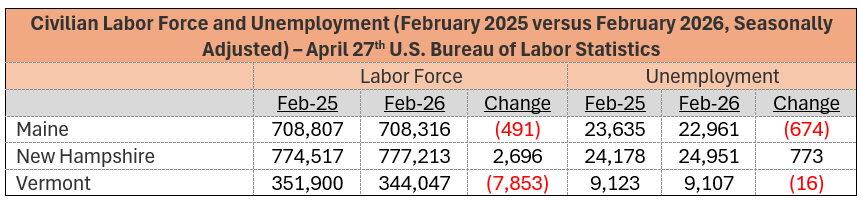
The recent data is a mixed bag for Northern New England. Generally, industries that feature higher wages and better benefits experienced declining employment. At the same time, some important but lower wage industries experienced decent growth from February 2025 to February 2026; however, the prospects for those industries during the rest of 2026 are clouded by a very constrained labor market (due to demographic and immigration policy constraints). For a deep dive on the regional economy, please check out the Boston Fed’s April 14th New England Economic Conditions. For additional context, the Beige Book is an invaluable real-time resource that (released every 6 weeks).
On April 27, I enjoyed a spectacular day here in Midcoast Maine; also, I was able to check out the most recent release of state-level employment data (LAUS). We’ll keep an eye out for revisions, but the early returns indicate that New Hampshire experienced significant job growth from February 2025 to February 2026, while Vermont experienced job losses, and Maine more or less held steady.
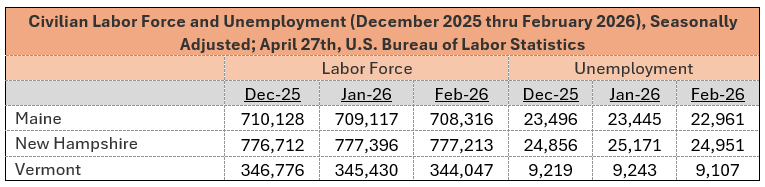
The labor force in Maine and Vermont shrank somewhat during the three months that began on December 1, 2025, and ended on February 28, 2026, while experiencing modest growth in New Hampshire. The number of unemployed individuals in the labor force was little changed across the region.
The Philadelphia Fed released its state coincident indexes on April 28th, and the release indicates strengthening economic performance across the region in February. Fingers crossed and all of that…
Co-working space, flexible/shared offices, incubators, and accelerators
Northern New England is an attractive place to live due to the many amenities that contribute to the high quality of life. At the same time, workers relocating to Northern New England often find that there aren’t a lot of places to set up their laptop outside of the home – the office market is limited outside of the metropolitan areas, real estate isn’t cheap, and most communities have a limited inventory of “third places” (i.e., public places that are not work or home). This is where options such as co-working, flexible/shared office space, incubators, and even accelerators can come into play. Before we dig into definitions, let’s establish some basics about the market:
- Office markets in Northern New England have very low vacancy rates…but office demand generally does not justify new construction at the price points that are achievable in the region.
- Many communities have retail properties that are difficult to backfill (e.g., former department stores) and/or industrial spaces that are obsolete (e.g., former mills). Co-working spaces or shared/flexible offices are sometimes a solution to the problem of “what to do with this building.”
- White collar employers in the region are generally much smaller than they are elsewhere, making it difficult to justify or configure traditional multi-tenant spaces.
- Previously, high-speed internet was not available in many residential areas around the region. Many knowledge-economy workers valued the access to broadband that was available in offices and that was not available to them at home. This dynamic has changed as faster internet has become more broadly available in small and rural communities around the region.
Shared offices versus co-working spaces
“Co-working spaces” tend to serve self-employed individuals and one-person regional offices with the occasional startup mixed in. Co-working spaces typically include a mix of hot desks, designated desks, phone call rooms or quiet rooms, lounges, and kitchens. The business model is often membership/subscription based; the monthly fee covers access to the internet, the facility, desks (often on a first come, first served basis), and community or social events. In some cases, the monthly charge also includes printing or even a mail room (giving subscribers the opportunity to have a professional address). Customers are charged either per use or per month, allowing small and new businesses to have some of the benefits of a physical business location without the downside of committing to a longer-term lease or needing to purchase/lease furniture and equipment.
“Shared office spaces” are a somewhat more structured environment in which multiple companies rent individual private offices inside a larger facility (sometimes these are referred to as “executive suites”). Shared office spaces often include a staffed reception with mail room, shared meeting rooms that can be “checked out” by tenants, a kitchen and in some cases a break or lunchroom. Increasingly, commercial property owners are responding to the market’s demand for shorter and more flexible leases in shared offices.
As between the two, co-working tends to be the preferred option among those whose businesses are not “client facing,” while client-facing businesses and businesses that must maintain the confidence of their clients tend to prefer shared offices. Shared office spaces tend to involve less community programming and less social interaction among tenants. The low upfront costs of co-working space, and the month-to-month nature of the commitment, make co-working the preferred option for most freelancers.
How are business incubators different from coworking or shared offices?
A business incubator is designed to provide early-stage startups with the resources they need in order to grow. The services and amenities offered in a business incubator go beyond offering a physical location and social programs. Incubators might provide or facilitate mentorship and education, leveraging existing programs like SCORE or developing their own roster of mentors and educators. Incubators also facilitate access to experts and business service providers in the community, such as attorneys and accountants and bankers who want to work with startup firms and entrepreneurs.
More sophisticated and well-funded incubators might also facilitate access to capital through pitch competitions, while some even take equity interests in the firms in their portfolio. Some even provide experienced management teams or individuals who can serve as “entrepreneurs-in-residence” to help people with great ideas and underdeveloped business skills.
Because incubators provide additional services, they tend to be more selective and to rely on outside capital (such as state funding) and institutional partners (such as a university). In some cases, business incubators focus on firms in a specific industry – doing so can facilitate more targeted/relevant programming, such as brown-bag lunches about narrowly targeted federal funding for research. One principle of incubators is that tenancy is time-limited, i.e., at some point the incubator companies “graduate” to make room for the next firm or cohort of firms.
What is a virtual incubator?
Virtual incubators provide a process for developing business ideas into viable businesses. In short, they provide some combination of support to participating businesses and opportunities for virtual networking, but without the physical office. If the goal of an incubator is to leverage the “magic of co-location” to boost a place-based entrepreneurial ecosystem, virtual incubators are not an answer. However, virtual incubators might be appropriate for building industry clusters in large metro areas or building a pipeline of startups in an incubator that is funded by venture or institutional capital. While the “virtual” nature of these incubators draws on some of the same impulses that have led many to choose remote work, virtual incubators will not solve the two primary problems facing knowledge industry workers in rural communities in Northern New England, which are the absence of appropriate locations for daytime remote work and the desire for some amount of social interaction and networking opportunities for those who work by themselves.
What is an accelerator and how is it different from an incubator?
Accelerator programs are similar to incubators in some respects (e.g., participants will have access to some professional services and relevant educational programming), though they are more likely than incubators to include funding or access to capital, pitch competitions, etc. Because accelerators provide significant resources to participating firms, they tend to be “time limited,” i.e., firms participate for 3 to 6 months. Because accelerator participants tend to be more mature firms, these programs are often virtual or hybrid in nature.
Incubators tend to be set up to nurture small/new businesses, often for years, through many stages of a company’s growth and development (including developing a business plan). In contrast, the purpose of an accelerator program is to rapidly scale up a small business that already has a minimum viable product. As such, accelerators tend to focus on technology companies or companies in goods-producing industries, and accelerator participants tend to be more established as firms or firms that are founded by serial entrepreneurs. Because accelerator program participants tend to be from a limited set of industries, they are often afforded significant opportunities to network with and be mentored by successful entrepreneurs in similar or adjacent industries.
Reach out and tell me about your favorites!
If you have had a positive experience using a co-working space, an incubator, an accelerator (or something in between!) please reach out and let me know what you liked about it at jacob@harpswellstrategies.com. Please put “Northeasterly” in the subject line!
Keep an eye out for more from Northeasterly! We’ll be back soon with some analysis of innovation centers and business incubators
Northeasterly is published by Harpswell Strategies, LLC, a Maine-based economic development and public policy consultancy. This content is researched and written by @Jacob Sesker (Principal), with help from two talented young analysts: @Addison Davis and @Oscar Herrera. To contact Northeasterly, e-mail jacob@harpswellstrategies.com and reference Northeasterly in the subject line.


