
Habits & Theory of Change
“We are what we repeatedly do.
Excellence, then, is not an act, but a habit.”
– Will Durant, from his 1926 work The Story of Philosophy
The above was Mr. Durant’s attempt to summarize the philosophy of Aristotle in a pithy turn of phrase. I would say he did an excellent job, given how often it is mis-attributed to Aristotle himself. While ultimately, I want to talk about Theory of Change, we will make a brief foray into Habits to lay some groundwork. A Theory of Change is a clear description and roadmap for how and why a desired change will be produced in a particular context. It defines for our project or program how we get from Point A (the current situation) to Point B (our desired situation and outcome). Producing change doesn’t occur in a vacuum. There are a history and a context that precedes any project or program. The better we understand how things are now and the momentum of the current moment, the better we can design an intervention.
Any critter or actor (or indeed any phenomena in the universe) can be conceptualized in terms of the things that it repeatedly does. Some of this understanding is baked into our language. Waterfalls are the place where the water, well… falls. In the US American context, we often ask each other “what do you do?” as an early icebreaker topic of conversation. Of course, we mean for work, as labor is the central organizing principle of US American life, but it reveals how the active part of our lives defines us. Indeed historically, we find that surnames often relate to the occupations of our ancestors, leading to many Cooks, Smiths, Carpenters, Bakers, and Millers. The whole world can be conceptualized as a series of habits, from individuals to organizations to states & nations. These habits interact; neutralizing, amplifying, and interfering with one another.
I was first introduced to this model by David Langner and Alex Nerguizian. At the time, I was running a program called Families Moving Forward, designed to “move the needle” on entrenched poverty in Cambridge. I brought these two gentlemen in for a workshop with my staff to understand habits, and habit change. A Habit is repeating the same behavior in the same context, and being rewarded for it soon after. Habits follow the same pattern of observable phenomena: a Cue triggers a Behavior, garnering a Reward. For a habit to be self-reinforcing, the Reward needs to follow quickly after the Behavior, in order to link the two.
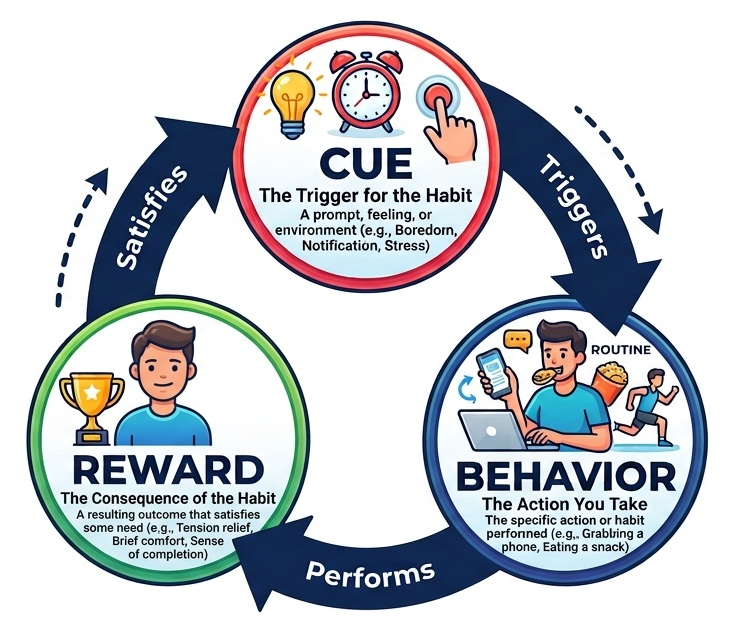
Behavior is generally the most easily observed part of the cycle. Once a behavior is identified to model or change, observe for the cue that precedes each instance. Let’s consider a fast-food restaurant. The drive-through dinger dings (cue), prompting the attendant to take and make the order (behavior). The car rolls up to the window and food is handed off in exchange for money (reward). Let’s consider something bigger, like an organization: when summer comes around again (cue), the summer camp program runs (behavior), generating the bulk of revenue for a community center (reward).
With this understanding, how do we change a habit? Considering they follow the regular pattern of cue, behavior, and a reward soon after, what ideas might the reader have for redirecting or stopping habitual behavior? We will discuss this in next week’s article.


