
Habit Change
A Habit is repeating the same behavior in the same context and being rewarded for it soon after. Habits follow a regular cycle: a cue initiates a behavior resulting in a reward. Habit change can come in two main flavors: Direct and Indirect. Direct methods involve influencing the habit cycle itself, while indirect methods influence the context in which a habit occurs.
Direct Methods
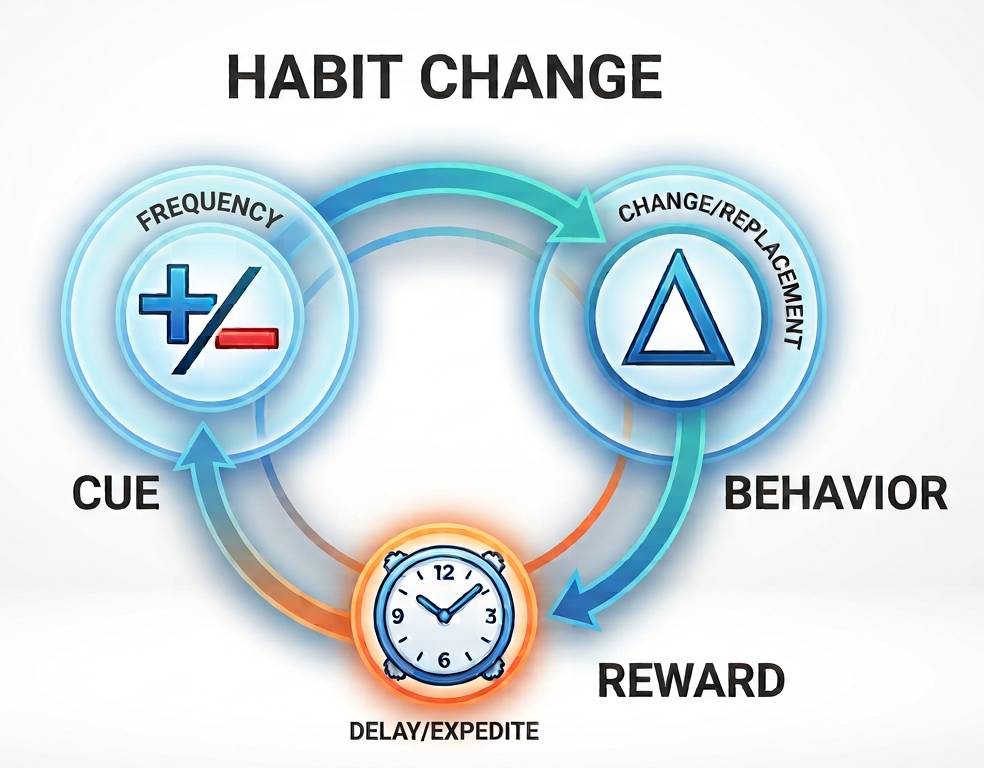
There are only three components to the habit cycle that we can influence:
- The Cue: by increasing or decreasing the frequency of its occurrence
- The Behavior in Context: replace the behavior or change the context (mental/physical)
- The Reward: by delaying or expediting the reward
The habit cycle is initiated by the Cue. More cues result in a greater frequency of habit occurrence. Fewer cues mean a lower frequency of the habit. For example, a person who spends more money than they would like on morning coffee could pick a different route to get to work, avoiding their usual coffee spot. In another example, a person seeking to do more exercise might place an over-the-door pull up bar in the doorway to their kitchen.
A habitual Behavior is one which occurs in the same context and satisfies some urge or need, often not fully conscious. If the urge or need can be identified, then this knowledge can be used to replace a negative habit with a positive one that feeds the same impulse. For example, smoking is often reinforced by the social aspect of spending time talking to people. It can help some people quit smoking, for whom socialization is the real reward, to call a friend when they feel the urge to light up. Alternatively, by changing the context in which the behavior occurs, it can be disjointed from its usual space. This could mean physically moving to a different space, or mentally shifting gears to something else. For example, if a feeling of anxiety cues a person to become aggravated in a crowded room, a useful change of context might be taking a walk in a peaceful setting. Similarly, when feelings of anxiety appear, a person might pick up a sudoku puzzle to shift their mental space to something different.
All habits exist and persist because we get something out of it. Even maladaptive and self-damaging behaviors carry some reward. Some people remain in unhappy marriages because the value they get from social approval is greater than the injuries of staying. Positive or negative, habits are reinforced when the reward is received soon after the cued behavior. By delaying or expediting the reward, the intensity of a habit can be modulated.
Indirect Methods
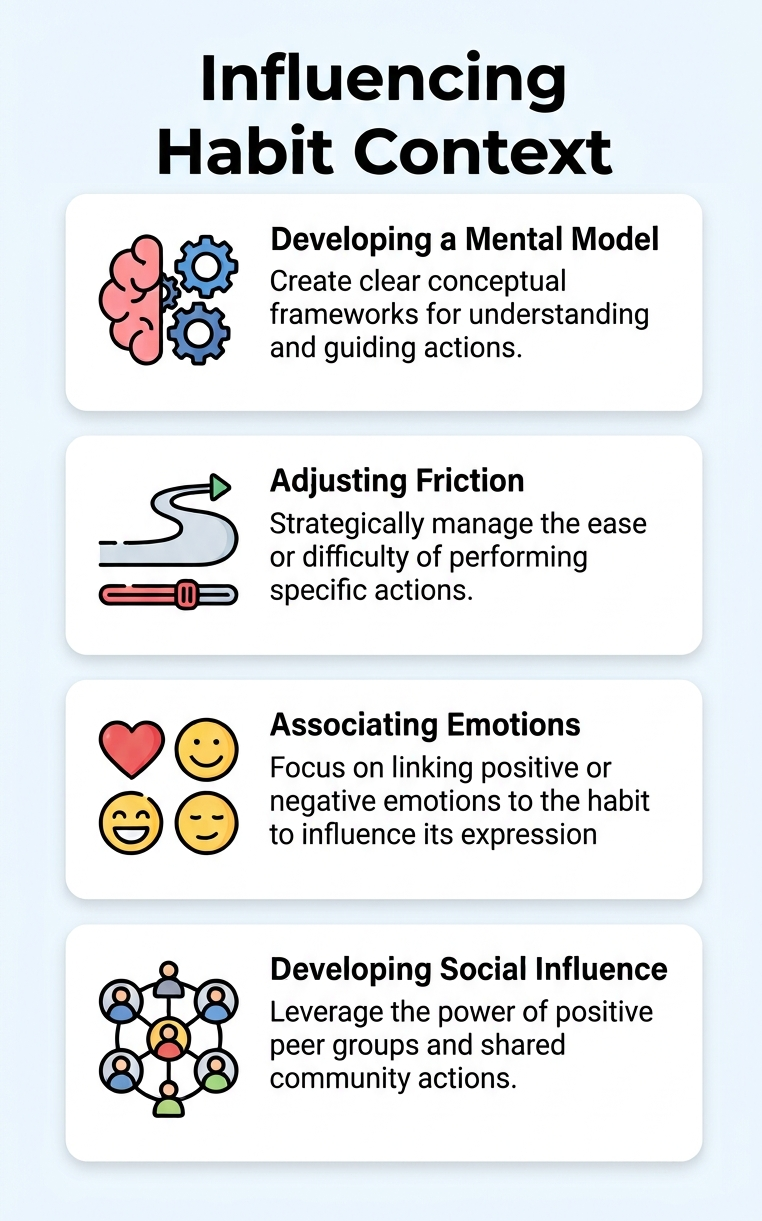
As an alternative to directly affecting the habit cycle, we can influence the context in which it occurs. The expression of a habit and the habit cycle is time limited within a broader environment, and changes to this environment will affect the expression of habit. We will discuss four main variables.
Sometimes, people simply lack a clear, step-by-step process to reach the desired outcome. By developing and distributing an understanding or Mental Model of how the outcome will be accomplished, this variable can be controlled.
Friction is anything that requires effort input to overcome. Friction takes the form of things like overcomplicated forms, lower than needed staffing, improper equipment, etc. In terms of habit change, the more difficult something is to do, the less likely it is that it will be done. To increase the frequency of a habitual behavior, lower friction. To decrease the frequency, increase friction. For example, if a person is seeking to control their food portions better, they might make smaller plates and bowls easier to reach than larger dishes in their kitchen.
The Emotions associated with something influence how likely we are to engage. When things make us feel bad, we tend to avoid them. When things make us feel good, we tend to seek them out. The more a desirable behavior can be associated with good feelings, the likelier it is that the behavior will occur.
One of the many oddities of human existence is that feeling bad can feel good. This is certainly the perverse reality of modern social media, where negative emotions garner more engagement than positive ones. Those sites generally work as echo chambers, so as we stew in anger and other negative emotions, we get to do it alongside other people who agree with us. Human beings are social animals, and heavily influenced by whether their social group supports or opposes their views and behavior. Social Influence can therefore be developed to influence broader group habits.
In the next article, we will discuss a systematic approach to habit change, and then extrapolate the principles to tie all of this habit talk back to the original subject: Theory of Change.


