
One-Time and Minimum Viable Actions
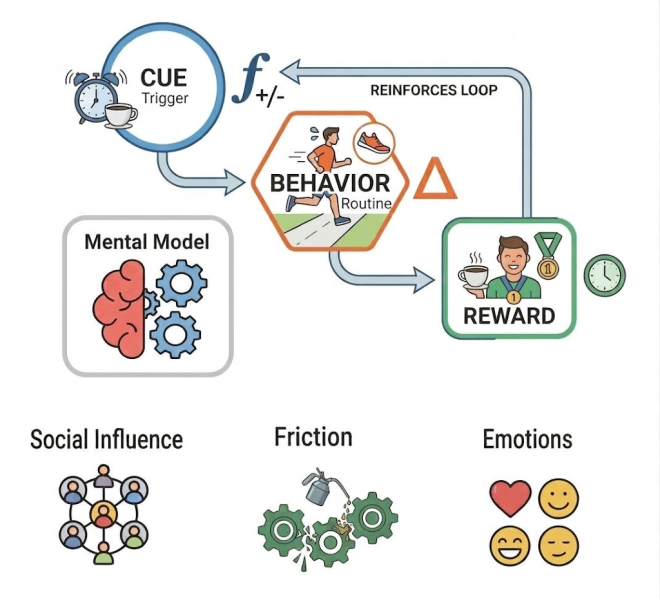
Now we come to designing an intervention. Knowing what we know about habits, what steps do we intend to take? Will we apply a Direct or an Indirect method? Some combination of the two?
Do we try to adjust frequency of a cue? Will we seek to replace a behavior, or change the physical or mental environment in which it occurs? Are we looking to delay or expedite a reward for a behavior? Do we educate folks about a particular model of how something can be done? Do we make a process easier (or harder)? Do we start a campaign to draw attention (and emotions) to a cause, or to concentrate social influence for or against it?
Once we know what we’d like to do, we need to establish how we’ll do it. Systematic habit change is effected by two primary routes: a One-Time Action (OTA) or a Minimum Viable Action (MVA). In the context of personal habit change, both options require Supportive Accountability.
Supportive Accountability consists of a number of factors. Most importantly is a two-way street for feedback, both offering insights and listening. Supportive Accountability requires clear expectations, with both Key Performance Indicators (KPIs) and SMART Goals. A KPI is the thing we are looking for to show that the plan is working (or not), and consists of observable and countable things (number of visits, pamphlets distributed, less algae in the pond, more foot traffic on Main St, etc). A SMART goal is Specific, Measurable, Achievable, Relevant, and Time-bound.
Supportive Accountability involves regular tracking and review of activities, by referencing the SMART Goals which were set. If a goal is not achieved in the time specified, then the support piece of the accountability means looking for training and tools that will facilitate achieving the goal. Always, whether looking to change behavior in ourselves or others, we should display unconditional positive regard.
An OTA is a single action that shifts the course of events. To illustrate this, consider setting a goal to get up early and take a walk outside every morning, regardless of weather. This could be a very difficult goal to achieve, especially in a New England winter. If a person were to adopt a dog, however, this goal would necessarily be achieved each morning, unless the would-be dog owner enjoys cleaning carpet. Adopting the dog is a single action that launches a whole new behavior pattern.
An MVA starts from a long-term goal, and works backwards to the smallest element or action that can be accomplished in the next 24-48 hours to move towards it. In order to be habit forming, the achievement must be celebrated soon after. In reference to getting up early and taking a walk outside, this might mean getting up earlier generally. An OTA of setting your alarm earlier will help accomplish the MVA of getting up.
That’s a whole lot of words, but how do we put it together? To summarize and illustrate, we will consider a commonly desired habit change: quitting smoking.
Let’s model the behavior:
- Cue: stress, feeling down, a desire for social interaction, chemical dependency on nicotine
- Behavior: going outside and smoking a cigarette
- Reward: nicotine rush, dopamine, social interaction, alone time to process
How will we go about changing it? First, let’s list some Indirect things we can do to influence the habit cycle:
- Mental Model: lay out a timeline for quitting, including reducing the number of cigarettes smoked from the current pack a day down to half a pack in two weeks, five a day by week three, and one a day by week four. Fully quite smoking by week six. Tell this plan to an accountability partner who will ask you about how you are doing (List of MVAs in order).
- Friction: throw out any cigarettes that you are currently in possession of, as well as any pocket-sized lighters (OTA).
- Emotions: write a list of all the reasons why you will quit smoking, associating negative emotions to the habit, ie “when I smoke, I miss out on time with friends who don’t” and positive emotions with quitting, ie “when I quit smoking, I will be able to taste food more clearly, and breathe better” and reread it whenever a craving hits (OTA, the use of which is an MVA).
- Social Influence: recruit friends to give you positive feedback when you reduce your cigarette intake, and to express their disappointment in you when you smoke (OTA).
Some Direct habit change tactics might include:
- Change commuting route to avoid the corner store where cigarettes are usually bought (Cue, OTA).
- Join a walking group for social interaction (Reward, OTA).
- Lay out your quitting timeline and recruit a friend to keep you accountable (Behavior, MVA).
- Purchase nicotine patches and nicotine gum to rein in chemical dependency (Reward, OTA).
- Get a deck of cards and play a round of solitaire every time a craving hits (Behavior, MVA).
In the next article, we will take this habit change model and transfer it to a new space: Theory of Change as it relates to economic or social development work.


